Historic preservation is not the bogeyman for finding cheap apartments in DC
Today's Post has an article, "The new housing market: Why it’s so hard to find a cheap apartment in Washington, D.C.," with this line about strategies for producing more and lower cost housing:
Too bad it's wrong. (The article doesn't say all that much considering.)In D.C., you could even ditch the large historic districts that make it extremely difficult to build anything substantial in many desirable neighborhoods.
The reason that it's hard to find cheap apartments in DC, is that relative to demand, there is lack of inventory.
But it's not because of historic districcts.
It's because historically, DC had been a small city relatively speaking, and not an industrial city, which would have led to the construction of more and higher capacity apartment buildings and tenements.
Instead, especially in the late 1800s and into the early part of the 1900s, mostly single family housing (rowhouses) was constructed in those inner city neighborhoods that are now considered desirable.
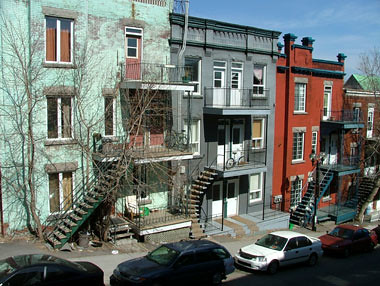
Plexes in Montreal.
Compare that to cities like New York (tenements and "walkups"), Cleveland or Boston (three-story buildings with two or more apartments on each floor), and Montreal (plexes--three-story buildings constructed on the equivalent of two rowhouse lots, with 5-6 units total) where the focus was on constructing residential buildings with multiple apartment units.
And even in neighborhoods where there is a mix of apartment buildings and single family housing, like Dupont Circle or parts of Capitol Hill, Columbia Heights, etc., the apartment buildings aren't that big, limiting inventory.

When demand is high and inventory is low, prices are high.
Personally, I think that neighborhoods with a mix of residential building types are more resilient.
... but getting back to the quoted piece, again, removing historic designation wouldn't all of a sudden yield "cheap apartments," because the issue is lack of apartments, not historic designation.
By definition, newly constructed apartments are priced at today's market rates, so prices are "high."1022 3rd Street NE" height="343" src="https://farm1.staticflickr.com/21/99177003_c73c83aef5.jpg" width="400" />
These "Wardman style" rowhouses at 1022 3rd Street NE were torn down in the mid-2000s in favor of a large multiunit apartment building. (The buildings were left to decay while the developer was assembling the block.)
This Queen Anne style rowhouse, dating probably to the 1890s, was at the southwest corner of 3rd and K Streets NE.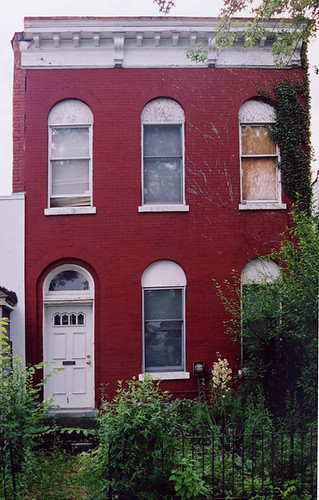
So if you were to tear down a bunch of houses, in this case, rowhouses that would be eligible for designation, but were not in a historic district, such as what was done on the 1000 block of 3rd Street NE, where a block of rowhouses were torn down to build the first phase of the Loree Grand apartment building on the 200 block of K Street NE, what is produced are new apartments constructed at current costs, which are priced at the high end of the market.Loree Grand apartment building, Washington, DC" height="355" src="https://farm2.staticflickr.com/1382/5123289414_f774f70b64.jpg" width="400" />
In 30 years or so, the prices will end up being lower relative to new construction. But that doesn't mean much to people today.
According to the Loree Grand website, rental rates for apartments range from about $1,500 for the smallest studios to not quite $4,414/month for a 1,318 s.f. unit. Prices are dependent on the size of the unit.
And this would be the case, if you were to tear down historic houses too, although prices would end up being even higher, because of the higher costs involved in assembling land.
Labels: historic preservation, housing choice, housing market, housing policy, multi-unit housing, real estate development, real estate market

Comments
Post a Comment